
x
If you’re weighing home EV charger installation, this guide walks through how Level 1 and Level 2 charging work, what’s different about a Tesla Wall Connector, and how an installer near you evaluates panel capacity, safety, location, permits, and the real cost of putting a charger in your garage.
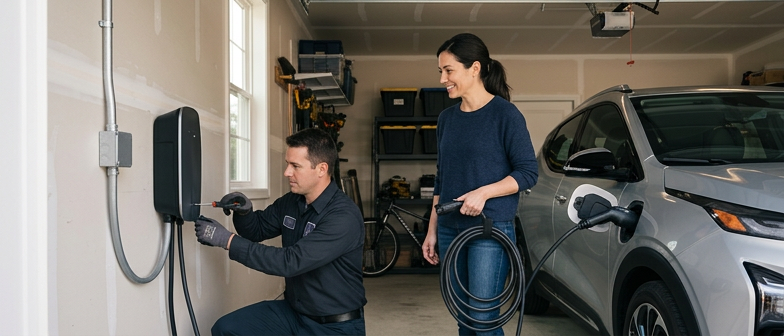
Electric car charger installation at home uses the same electrical system that powers your lights and appliances, but on a dedicated circuit sized for higher, continuous loads. A line runs from your electrical panel to a charging point in your garage, driveway, or carport. The charger, often called EV supply equipment, communicates with your vehicle to deliver the right amount of power and shuts off when the battery is full. Before you think about equipment brands or prices, consider how much you drive, where you usually park, and whether your panel can safely support another high‑demand circuit.
Most homeowners start by comparing standard Level 1 charging with a Level 2 EV charger installation. Level 1 uses a regular 120‑volt outlet and the cord that comes with many cars, adding only a few miles of range per hour, which suits shorter daily commutes. Level 2 uses a 240‑volt circuit and a wall‑mounted unit, often what people picture when they plan home EV charging. Because Level 2 draws more power, it usually requires a correctly sized breaker, proper wiring, and professional evaluation of panel capacity and safety so you know the likely installation effort before you look at costs.
Before any electric car charger installation at home, think about how you use your vehicle and where charging will be most convenient and safe. Consider where you usually park, how far that spot is from your main electrical panel, and whether the area is protected from rain and snow. A good location for Level 2 EV charger installation has clear space around the car, enough wall room for the unit, minimal trip hazards from cords, and, if needed, access to reliable Wi‑Fi for a smart charger. Deciding this early helps you avoid changes that add time and cost.
Next, get a basic sense of your home’s electrical capacity before anyone mounts hardware or runs conduit. Check the amperage rating on your main service panel and note how many open breaker spaces you have, but do not remove covers or touch wiring. A 240‑volt Level 2 circuit can be a significant new load, especially in older homes. A licensed electrician should perform a load calculation, confirm whether your panel can handle another circuit, and explain if you need upgrades such as a subpanel or service increase to support regular EV charging.
Once you understand your capacity, contact a qualified EV charger installer near you rather than treating this as a do‑it‑yourself job. A licensed pro will review your chosen location, measure the run from the panel, check grounding and code compliance, and recommend options that match your driving habits and budget. They can also help with permits and inspections so the work meets local electrical codes and manufacturer requirements, making your home charging setup safer, more reliable, and ready for future EVs.
| Checklist Item | What to Look For | Risk Level if Ignored | When to Call an Electrician |
|---|---|---|---|
| Parking and charger location | Close to panel, weather‑sheltered, clear walking space | Medium | If ideal spot is far from panel or outdoors |
| Cord routing and trip hazards | Short, tidy cord path away from doors and clutter | Medium | If cord must cross walkways or tight spaces |
| Panel amperage rating | Label clearly showing overall service rating | High | Always, before adding a Level 2 circuit |
| Open breaker spaces | Enough unused slots for a new double‑pole breaker | High | If panel is full, crowded, or unclear |
| Load and future expansion | Room for regular EV charging plus other large appliances | High | If you plan more EVs or new major loads |
| Permits and code rules | Local approval and inspection requirements understood | High | Before any wiring, conduit, or wall cuts |
When planning electric car charger installation at home, safety starts with confirming that your existing electrical panel, wiring, and grounding can handle the additional load of a Level 2 EV charger installation. A licensed electrician should perform load calculations, verify the condition and rating of circuits and breakers, and ensure the charger is properly grounded and protected by the right overcurrent device. They should also verify that the selected charging equipment is listed by a nationally recognized testing laboratory and is suitable for indoor or outdoor use, depending on where you plan to mount it.
When planning electric car charger installation at home, your first choice is between a basic Level 1 cord and a Level 2 EV charger installation. Level 1 uses a standard outlet and can work if you drive short distances and can leave the car plugged in for many hours. Most drivers prefer a Level 2 unit because it charges much faster, making it easier to recover range between daily commutes or weekend trips. Think about how many miles you drive, how often you arrive with a low battery, and how long your vehicle usually sits parked at home before deciding which charger truly fits your routine.
If you decide on a Level 2 charger, compare charging speed, Wi‑Fi or app controls, load management, and whether the unit is rated for indoor or outdoor use. For Tesla owners, a Tesla Wall Charger installation can be convenient because the connector is built for the vehicle and can support higher charging rates, while many households choose universal Level 2 models that work with different EV brands on the same circuit. Look for equipment tested by a recognized lab and match the unit’s capacity to your car’s maximum charge rate so you are not paying for unused power or installing a charger that is too weak for your needs.
Your home’s electrical system matters as much as your driving habits. Before moving ahead with home EV charger installation, confirm whether your panel has enough capacity and where the charger will be mounted relative to your parking space. A licensed electrician can recommend the right circuit size, cable run, and mounting location so the equipment is safe, convenient to use, and compliant with local codes, giving you a practical, future‑ready setup instead of one that feels limiting or demands costly upgrades later.
A Tesla Wall Charger is a common type of Level 2 EV charger installation that uses a dedicated 240-volt circuit for faster charging. An electrician will check your panel capacity, run a new circuit with the right amperage, and set the charger output to match both the breaker size and your vehicle’s onboard charger. Any brand-specific unit should be safety certified, mounted according to its indoor or outdoor rating, and installed per the manufacturer’s instructions.
If you have more than one EV or may switch brands later, discuss connector types and adapter options with your installer. Some Tesla models can charge from other Level 2 home stations, and many non-Tesla vehicles can use a Tesla unit with the right adapter, but the circuit still has to be sized correctly and current limits set. Also ask about load management, app controls, and how the charger will work with your overall home electrical system.
When you start planning electric car charger installation at home, the quote often includes more line items than expected. The total cost combines the price of the charger, the electrical work to power it, and any upgrades needed to keep your home safe and code compliant. For a typical Level 2 EV charger installation, costs can range from a few hundred dollars for simple setups to several thousand when electrical systems need significant work. Knowing what drives the price helps you compare bids and avoid unpleasant surprises.
The largest part of the home EV charger installation cost is usually the materials and labor for the new circuit. A wall-mounted Level 2 unit needs a dedicated breaker, correctly sized wiring, and mounting hardware, all installed by a licensed electrician. Costs rise if the electrical panel is far from the parking area, because longer conduit runs take more time and materials. If your existing service panel is near capacity, you may also need a panel or service upgrade, which can quickly become the priciest part of electric car charger installation at home, especially in older houses.
Permits, inspections, and safety features round out the typical cost. Many local building departments require a permit and final inspection to confirm that wiring, grounding, and breaker sizes meet code, and those fees are usually included in your quote. You may also pay more for trenching if the charger is installed away from the house, or for added protection such as weatherproof enclosures and surge protection. When you request estimates, ask for an itemized breakdown so you can see what you are paying for in equipment, labor, upgrades, and permitting, and choose options that fit your budget without cutting corners on safety.
How does home EV charging work before I schedule an installation near me?
A home EV charger runs on a dedicated circuit from your electrical panel to a wall unit in your garage or driveway. It communicates with the car to set a safe power level, supplies power, then stops when the battery is full. You need enough panel capacity and a practical parking spot.
Where should I place an electric car charger at home?
Install it where you usually park, with wall space, room to walk, and no cable tripping hazards. A shorter run to the panel usually cuts cost. Outdoors, pick a spot with some weather protection and lighting.
What should I review with an EV charger installer near me about safety and code?
Ask for a panel load calculation, proper grounding and bonding, correct breaker and wire size, and a charger listed by a recognized testing lab and rated for indoor or outdoor use. All work should follow local code and permit rules.
Is a Level 2 EV charger installation worth it compared with a standard outlet?
If you drive only a little and charge overnight, a Level 1 cord may be fine. If you commute more, share the car, or arrive home with a low battery, Level 2 charging is usually worth it because it refills miles much faster.
What drives the home EV charger installation cost for something like a Tesla Wall Charger?
Cost depends on panel capacity, distance from panel to charger, whether walls must be opened, and any service upgrades or permits. A simple short run from an adequate panel is far cheaper than a long 240‑volt circuit or replacing the main service.